How ACS South Built Better Managers Through Cohort-Based Training
Key Takeaways
ACS South, a 140-person flooring installation company, was promoting strong performers into management roles without formal training. It’s one of the most common patterns in growing companies.
Their previous training approach (multi-day, in-person sessions) wasn’t creating lasting change. Managers walked away inspired but didn’t shift how they led.
Through Oxygen’s Management Essentials program, a six-month cohort-based experience, ACS South gave their managers the tools, confidence, and peer support to lead differently.
The results: fewer HR escalations, stronger performance reviews, more confident managers, and a lasting peer network across industries.
ACS South is planning to enroll future cohorts as part of a long-term leadership development strategy.
When Great Performers Become Untrained Managers
Here’s a story you’ve probably lived: someone on your team is crushing it. They’re reliable, driven, and great with clients. So you promote them into a management role. And then things get bumpy.
They’re suddenly responsible for giving feedback, running 1-on-1s, navigating conflict, and making decisions that affect other people’s careers. But they were trained to execute, and now they’re expected to lead
That’s exactly what happened at ACS South, a 140-person flooring installation company with a strong promote-from-within culture. CEO Joe Santagata, COO Ed Camp, and Director of HR George Garcia all saw the same thing: their best people were stepping into management roles and struggling with the people side of the job.
“We promoted strong performers into leadership roles, and we wanted to help them mature in the people side of the job,” said Ed Camp, COO of ACS South. “Things like communication, confidence, and tough conversations.”
George Garcia, Director of HR, saw it play out during performance reviews and everyday employee conversations.
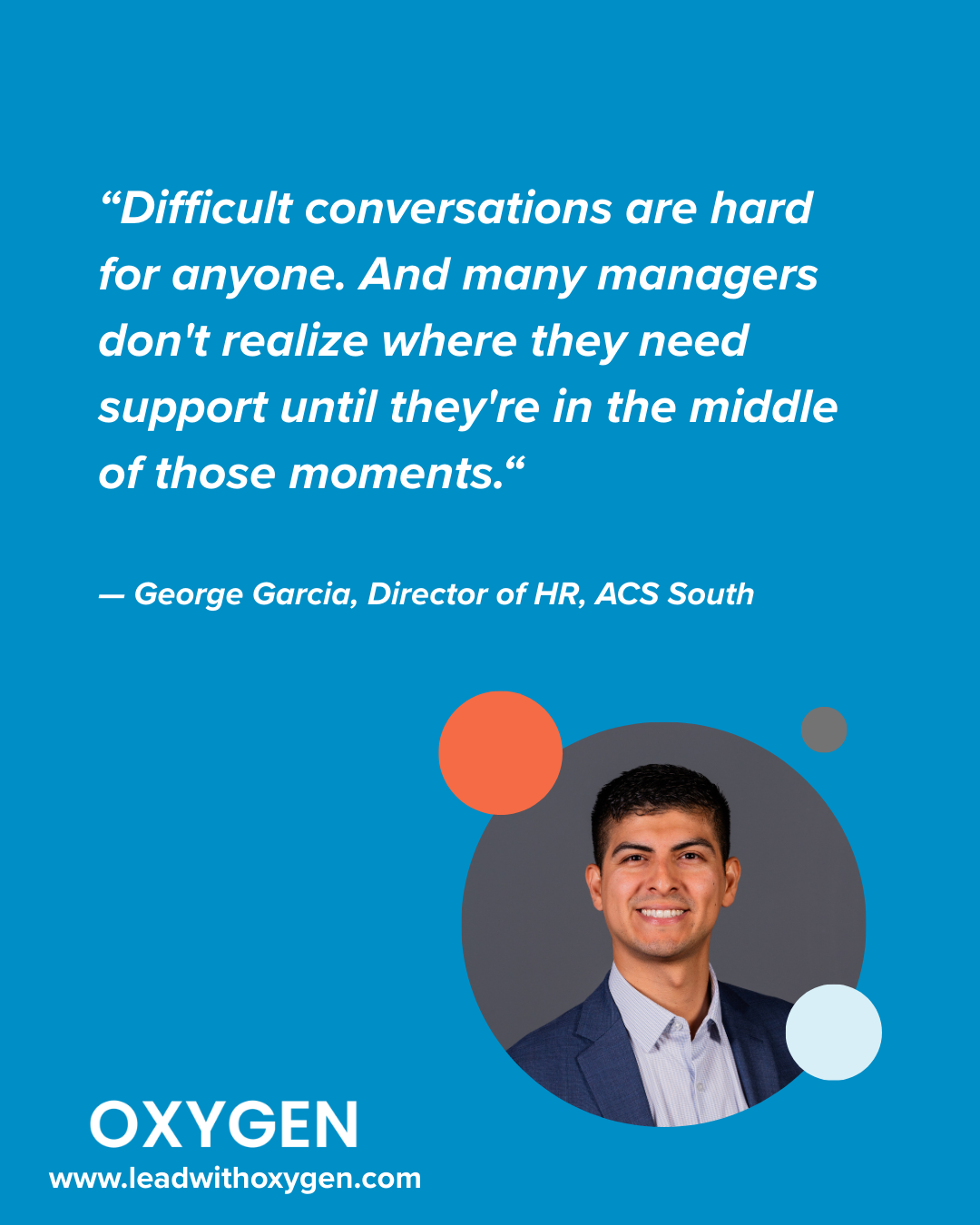
“Difficult conversations are hard for anyone,” Garcia said. “And many managers don’t realize where they need support until they’re in the middle of those moments.”
The Cost of Undertrained Managers
ACS South’s experience is far from unique. The data paints a clear picture of what happens when managers don’t get the support they need.
Managers drive 70% of team engagement. According to Gallup’s 2025 State of the Global Workplace report, 70% of the variance in team engagement comes down to the manager. Globally, engagement fell to just 21% in 2024, costing the economy an estimated $438 billion in lost productivity.
Half of employees leave because of their manager. Gallup’s ongoing research shows that 50% of employees who quit cite their manager as the primary reason.
Engaged teams outperform across the board. Gallup’s meta-analysis found that highly engaged business units see 51% lower turnover and 23% higher productivity. That’s a competitive advantage.
Most managers have never been formally trained. Fewer than 44% of managers globally have received any formal management training. But for those who do, Gallup found it cuts active disengagement in half.
Only 37% of new supervisors get training when they’re promoted. And according to Emergenetics, 74% never receive ongoing development after that.
At ACS South, these gaps showed up as more HR escalations, weaker performance reviews, and managers who avoided tough conversations.
“Invest in management training unless you want countless meetings managing the managers,” Garcia said. “When you give them the tools, HR can be strategic, not the people police.”
Why Previous Training Wasn’t Creating Lasting Change
ACS South had invested in training before. They’d sent managers to multi-day, in-person sessions. The content was solid. But the format wasn’t producing lasting behavior change.
“When you sit in a room for hours at a time, you might walk away with a couple of things, but it doesn’t always stick,” Garcia said. “That’s not how learning works.”
The reality is that one-off workshops create a burst of awareness, but without reinforcement, practice, and accountability, most of what’s learned fades within weeks. The information-dump model of training feels productive in the moment but rarely changes how managers actually lead.
What a Better Approach to Manager Development Looked Like
As ACS South evaluated new approaches, three things became non-negotiable:
1. Learning that managers could apply right away. ACS South wanted managers to walk out of each session with something they could use that week. “It was almost like hitting reset on what the foundation of managing people should be,” Garcia said.
2. A space outside the company. Internal training has its place, but Garcia saw how it limited honesty. “You can always train internally,” he noted. “But you’ll never hear the full story if people don’t feel comfortable sharing it.”
3. Exposure to peers outside their industry. ACS South wanted managers to learn alongside people from completely different companies. “Hearing how managers in completely different environments approach the same challenges was eye-opening,” Garcia said.
The Program: Oxygen’s Management Essentials
Oxygen’s Management Essentials program is a six-month, cohort-based manager training experience designed around real-world scenarios, peer discussion, and practical application.
ACS South enrolled an initial group of managers including:
First-time managers stepping into leadership for the first time.
Experienced managers who had never received formal training.
High-potential leaders connected to succession planning.
“We were very clear,” Garcia said. “This was a commitment, and we were investing in them.”
Over six months, participants worked through a structured curriculum covering the skills that actually drive team performance: holding effective 1-on-1s, giving and receiving feedback, delegating, managing up, and navigating difficult conversations. Each session built on the last, with real-world assignments and peer accountability in between.
The Results: Observable Shifts in How Managers Lead
The shifts weren’t dramatic overnight. But they were consistent, and they showed up in the places that mattered most.
Fewer HR Escalations, More Manager Ownership
This was one of the biggest changes from HR’s perspective. Instead of coming to Garcia’s team asking them to fix things, managers started arriving with a plan and asking for input. That’s a fundamental shift from dependency to ownership.
More Confident, More Grounded Managers
Over time, leadership noticed that managers were showing up differently. More grounded. More sure of themselves. The language in performance reviews changed. It became more constructive, more growth-oriented.
“The biggest change I’ve seen is confidence,” said Ed Camp, COO. “Not overnight, but consistently.”
Stronger, More Intentional 1-on-1 Meetings
Managers started treating their direct report conversations as real development opportunities. That kind of shift doesn’t show up in a dashboard, but it changes how a team feels over time.
A Peer Network That Outlasted the Program
One of the most unexpected outcomes was the relationships. Managers built lasting connections with peers from other companies in their cohort, and those relationships continued long after the program ended.
“You could run a flooring installation company or be the CFO at a global brand,” said Mark Boulger, an ACS South participant. “At the core, leadership is leadership.”
Garcia summed up the transformation simply:
“They’re still the same people. They just have better tools to say the same things in a way that lands.”
Why Cohort-Based Manager Training Produces Stronger Results
ACS South’s experience is a clear example of why the cohort model works where traditional training falls short:
Spaced learning over six months gives managers time to practice and apply new skills between sessions. That’s where real behavior change happens.
Peer accountability keeps managers motivated to follow through, during the program and after.
Cross-industry learning exposes managers to perspectives they’d never get inside their own company. It’s one of the most consistently valued parts of the experience.
An outside environment gives managers the psychological safety to be honest about their challenges in a way that’s hard to replicate internally.
Practical, scenario-based curriculum means managers learn things they can use the same week.
Making Manager Development Ongoing
ACS South is treating this as a long-term investment. The company is planning to enroll new groups of managers in Oxygen’s Management Essentials and exploring additional development opportunities for more senior leaders.
“Just because one group went through doesn’t mean we’re done,” Garcia said. “We’re building a bench.”
That’s the kind of thinking that turns manager development from a one-time expense into a competitive advantage.
Ready to Build Stronger Managers at Your Organization?
If you’re promoting strong performers into management roles and wondering why the transition isn’t going as smoothly as you’d hoped, you’re in good company. Most growing companies face the same challenge.
The good news? It’s fixable. And the results speak for themselves.
Read the full ACS South case study to see how Oxygen’s Management Essentials program helped their managers lead with more confidence, communicate more effectively, and take real ownership of their teams.
Read the case study